Modern privacy regulations give every user the right to have their personal data deleted promptly: the right to be forgotten in the EU’s GDPR obliges service providers to comply with erasure requests within 30–60 days, California’s CCPA/CPRA require acknowledgment within 10 days and a response within 45, and Virginia’s VCDPA allows 45 business days [4]. Non-compliance is expensive — between January 2020 and January 2022 alone, GDPR penalties amounted to $1.2B, including fines against Amazon ($877M), WhatsApp ($255M), Google Ireland ($102M), and Facebook ($68M) [4].
Meanwhile, the data systems holding that data are built for the opposite goal. To sustain high ingestion rates, modern storage engines embrace the out-of-place paradigm — every write, including a delete, is an append. A delete merely inserts a tombstone that logically invalidates older entries; the physical data may linger in storage for an unbounded period of time [6]. And deletes are not rare events: ZippyDB, a distributed key-value engine storing metadata for images and videos, processes 25.2M delete requests in a 24-hour window — 6% of its entire workload [2]. The result is a fundamental mismatch between what regulations require and what state-of-the-art engines can deliver — in principle, the design goals of out-of-place systems are antithetical to those of timely delete persistence [5].
This project closes that gap end-to-end — at the engine layer [2][6], the visualization layer [1], and the language and policy layer [3][4][7] — turning delete into a first-class operation with a bounded, user-specified persistence latency.
How to persist deletes in a time-bound fashion without affecting the read/write performance of an LSM-engine, while supporting both primary and secondary range deletes?
Where It Started: Deletion as a Right
The thread began before the systems work, with the question of what GDPR enforcement means technically [7]. In a multi-stakeholder service architecture — data subjects producing data, a data controller provisioning the service, data processors (cloud and fog providers) computing on the data — honoring the right to erasure requires that (i) replication and dissemination of the data under erasure be stopped, and (ii) every replica held by the controller and all processors be erased, without undue delay. That work identified the core research challenges: a policy language in which users express retention preferences, enforcement of those policies across administrative domains, and — most stubbornly — system-level mechanisms that can actually delete data on time. The rest of this project is an answer to that last challenge.
The Problem: State-of-the-Art Engines Fail to Persist Deletes
LSM-trees power the storage layer of most modern data systems — RocksDB, LevelDB, BigTable, X-Engine, DynamoDB, Cassandra, HBase, MyRocks, CockroachDB. They achieve their celebrated ingestion throughput by being out-of-place: writes accumulate in a memory buffer and are flushed as immutable sorted runs, which background compactions progressively sort-merge. A tombstone — and the obsolete entries it shadows — can only be physically purged when it is compacted with the last level of the tree [6].
Two structural problems follow:
-
Delete persistence latency is unbounded. A tombstone must traverse every level of an exponentially growing tree, and that traversal is driven by the unique-insertion rate and the current tree height — neither of which the application controls. Worse, adversarial-but-realistic workloads (interleaved inserts and deletes on recently inserted keys) keep recycling tombstones through compactions in the upper levels indefinitely [2][6]. Until purged, the retained invalid entries inflate space amplification (a tombstone of a few bytes can invalidate arbitrarily many larger entries), pollute the Bloom filters (raising false-positive rates for every lookup), and inflate write amplification (invalid entries are re-compacted again and again).
-
Secondary range deletes require a full-tree compaction. When the delete predicate is on an attribute other than the sort key — “delete all entries with timestamp older than D days” on a tree sorted by
id— the qualifying entries are scattered across every level, every file, and every page. The only state-of-the-art remedy is to read, merge, and rewrite the entire tree: a stop-the-world operation whose cost is independent of how little data actually qualifies [6].
In production, engines paper over both problems with periodic full-tree compactions — typically every 15–30 days [2]. Engineers on Alibaba’s X-Engine team describe applications that retain data for 7 or 30 days and “daily delete data that turned 31 days old, effectively purging 1/30 of the database every day” — and report that forcing compactions to meet a delete-latency target “leads to significant increase in compaction frequency, and the observed I/O utilization often peaks. This quickly introduces performance pains” [6].
Engine Layer: Lethe and Lethe+
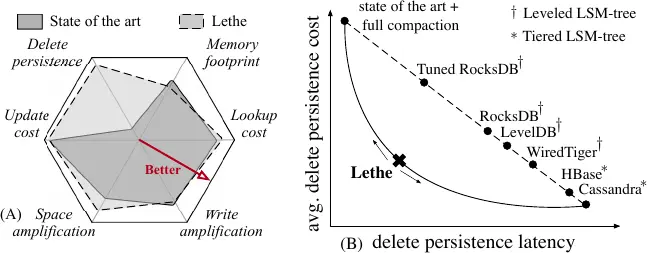
Lethe [6] and its journal extension Lethe+ [2] are the flagship contributions of this project: the first LSM engine to offer user-defined delete persistence guarantees while improving read performance. Lethe is built from two co-designed components — FADE, a family of delete-aware compaction policies that bound the delete persistence latency, and KiWi, a physical data layout that makes secondary range deletes practical — integrated into RocksDB with a fine-grained API for custom compaction triggers and file-picking policies.
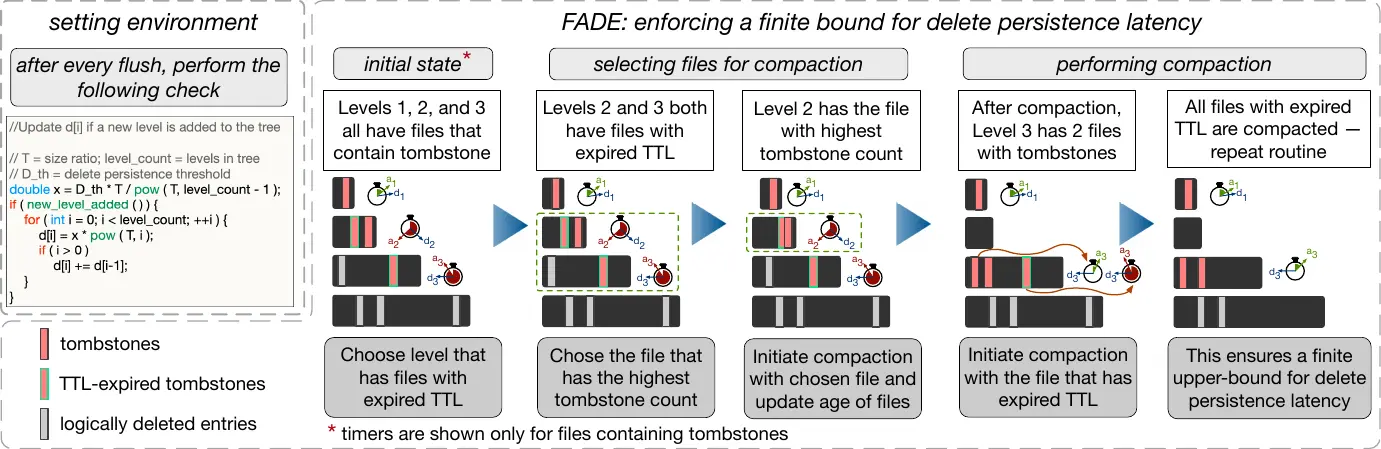
FADE: Bounding Delete Persistence Latency
FADE (FAst DEletion) takes a user- or SLA-provided delete persistence threshold — Dth, e.g., “30 days” — and guarantees every tombstone reaches the last level within it. The mechanism is a per-file time-to-live (TTL): Dth is partitioned across the tree’s levels as a geometric sequence matching the size ratio, so shallow levels (small, frequently compacted) get small TTL shares and deep levels (holding most of the data) get exponentially larger ones — guaranteeing files expire at a constant rate per time unit rather than all at once [6].
Compaction policy is then augmented on both sides. The trigger fires not only when a level saturates but also whenever any file’s TTL expires; the file picker prefers files with expired TTLs or the highest tombstone count, rather than the production default of smallest overlap. Crucially, FADE’s bookkeeping is free: it needs only the age of a file’s oldest tombstone and an estimate of the entries it invalidates, both computable from metadata LSM engines already maintain (sequence numbers, per-file entry and delete counts) — in practice, FADE leaves no metadata footprint [6]. FADE also suppresses blind deletes (tombstones against keys that don’t exist) with a Bloom-filter probe, and the TODS article adds a formal proof that every tombstone is persisted within Dth [2].
KiWi: A Storage Layout for Secondary Range Deletes
FADE bounds the latency of deletes on the sort key, but cannot help when the delete key differs from it. KiWi (Key Weaving Storage Layout) attacks this by adding one new layer to the LSM storage hierarchy: the delete tile, sitting between a file and its pages. The layout interweaves the two key orders — within a level, files are sorted on the sort key S; within a file, delete tiles are sorted on S; within a delete tile, pages are sorted on the delete key D; and within each page, entries are sorted on S again [6].
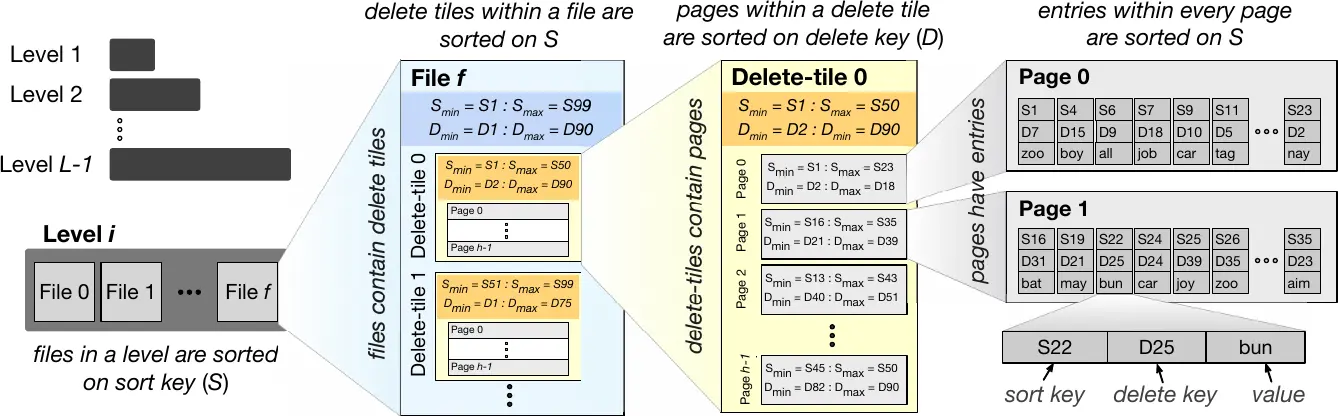
This interweaving has a remarkable consequence: the entries qualifying for a secondary range delete populate contiguous pages of each delete tile, which can be dropped wholesale — released to the file system without ever being read, merged, or rewritten (full page drops). Only the pages at the edges of the delete range need in-place editing (partial page drops, at most one per tile). Because each page remains internally sorted on S and Bloom filters move to page granularity (with the same total memory), point lookups retain state-of-the-art efficiency; the modest extra cost is more filter probes — and since hashing a key takes ~80ns against ~100µs for an SSD access, the CPU overhead is three orders of magnitude beneath the I/O it saves [6].
The single knob is the delete-tile granularity h (pages per tile): h = 1 degenerates to the classical layout; larger h serves more of each delete by full-page drops at a tunable penalty to short range lookups. Lethe derives the optimal h in closed form from just the workload mix — the frequencies of point queries, short range queries, and secondary range deletes [6]. KiWi+ [2] goes one step further and assigns a different granularity hi to every level: shallow levels — which serve a disproportionate share of early-terminating point lookups — get small tiles, deep levels get large ones. KiWi+ simultaneously reduces the memory of delete fence pointers and the CPU cost of filter probes, and pushes the read/delete Pareto frontier closer to the theoretical optimum. The TODS article also extends both layouts to tiered LSM designs (the optimal leveled tile is exactly √T̄ larger than the tiered one), making Lethe+ applicable to engines like HBase and Cassandra [2].
Key Results
Purging invalidated entries persistently cleans up the Bloom filters and lowers their false-positive rate, delivering 1.17–1.4× higher read throughput — lookups especially on deleted keys return with fewer disk I/Os than RocksDB. With just 10% deletes in the workload, timely purging keeps the tree nearly free of invalidated entries instead of letting them accumulate across levels, cutting space amplification by 2.1–9.8×. Eager merging makes Lethe write more data early in a workload, but the cost amortizes as later compactions touch fewer invalid entries — settling to under 1% write-amplification overhead over the lifetime of the workload. At the closed-form optimal delete-tile size, KiWi’s full-page drops realize a secondary range delete at a fraction of the cost of RocksDB’s full-tree compaction, achieving 76% lower I/O cost — with no loss in read performance.
Visualization Layer: Acheron
Tombstone dynamics are notoriously hard to reason about — they emerge from tree shape, workload, compaction trigger, and file-picking policy in ways no single benchmark number reveals. Acheron [1] is a demonstration system that lets researchers and practitioners watch the life cycle of tombstones: it runs FADE, MinOverlappingRatio (the production default), and Round-Robin compaction policies simultaneously on identical inputs, animating the evolution of three LSM trees side by side.
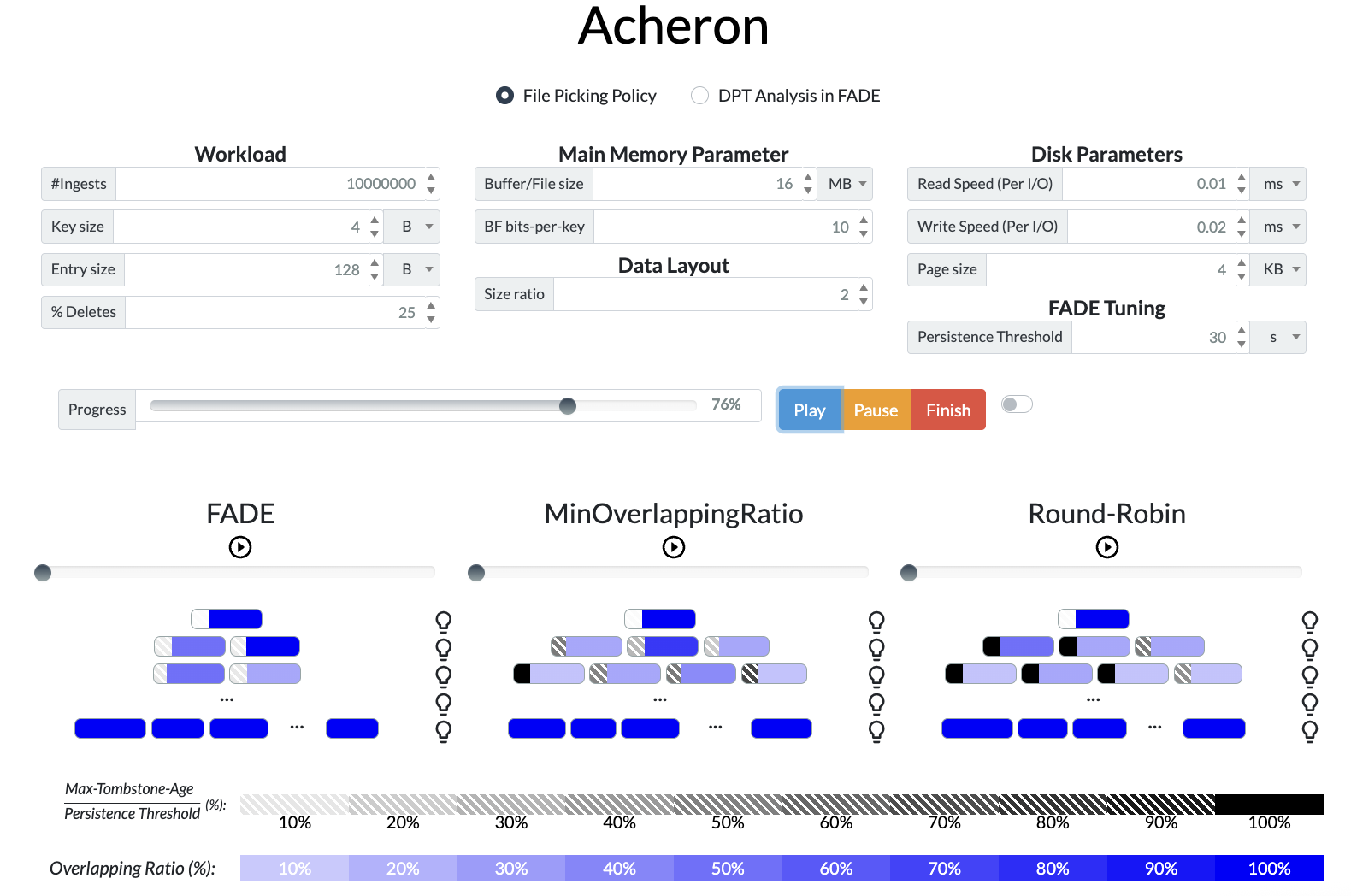
In the visualization, every file is a rectangle whose striped fraction shows its tombstone share and whose darkness encodes the age of its oldest tombstone — when a tombstone outlives the persistence threshold, the stripe turns fully dark. Watching the animation makes the project’s central claim immediately legible: under the state-of-the-art policies, dark (expired) tombstones accumulate and linger; under FADE, they never appear. Acheron is publicly available at disc-projects.bu.edu/acheron.
Language & Policy Layer
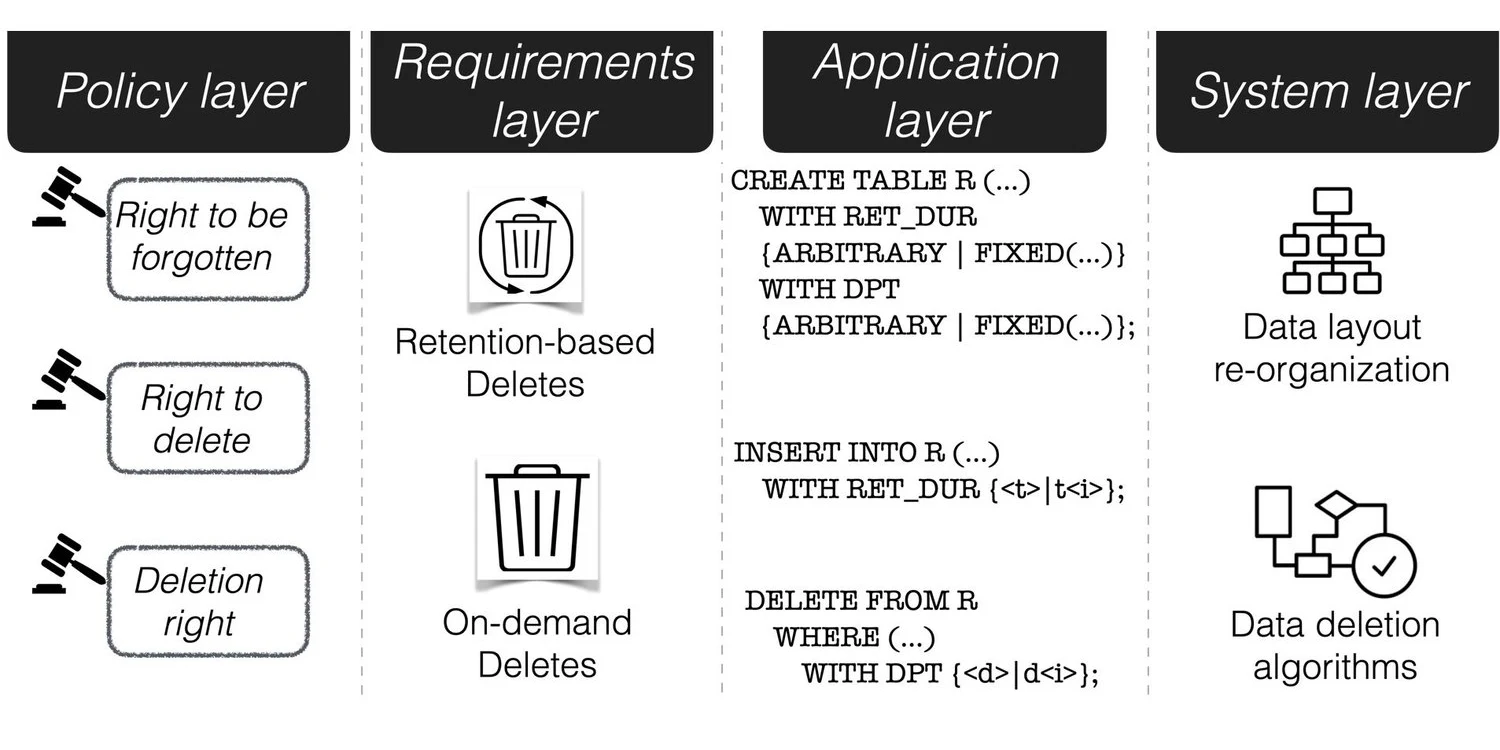
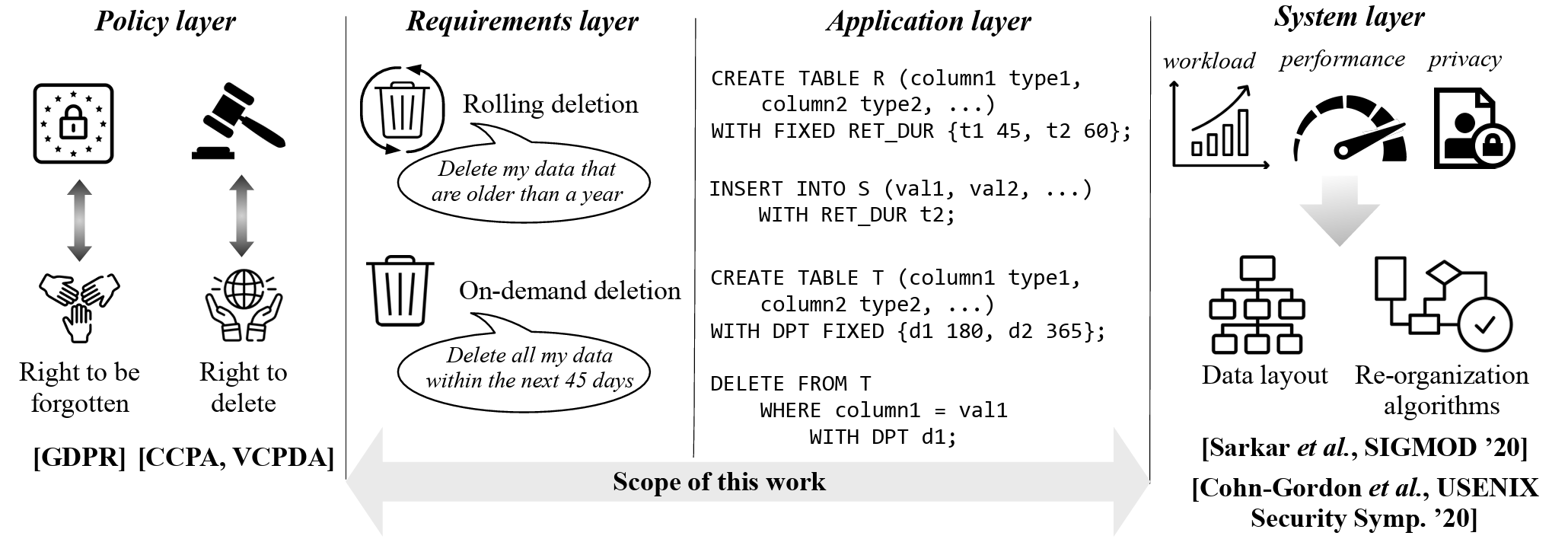
A perfect engine is useless if applications cannot ask it for bounded-latency deletion. From the regulations we distill two classes of deletion requests [4]: retention-driven deletes (“delete my data older than a year” — rolling, set once) and on-demand deletes (“delete all my data within the next 45 days” — ad hoc, user-triggered). State-of-the-art SQL can express neither. Our EDBT extensions [4] add a RET_DUR clause (retention duration) and a DPT clause (delete persistence threshold) to the DDL and DML, each supporting both pre-declared (FIXED) and ad hoc (ARBITRARY) thresholds:
CREATE TABLE T (column1 type1, column2 type2, ...)
WITH RET_DUR {ARBITRARY | FIXED (t1 <ret1>, t2 <ret2>, ...)}
WITH DPT     {ARBITRARY | FIXED (d1 <dpt1>, d2 <dpt2>, ...)};

INSERT INTO T (val1, val2, ...) WITH RET_DUR t1;

DELETE FROM T WHERE column1 = val1 WITH DPT d1;
The extensions are small and template-portable to other query languages (GraphQL, LINQ, N1QL), but they transform retention and deletion from out-of-band operational scripts into first-class declarative intent that the engine — Lethe underneath — can honor and audit.
The deletion-compliance framework [3][5] ties the whole stack together in a four-layer architecture: a policy layer (the regulations: right to be forgotten, right to delete, deletion right), a requirements layer (retention-driven vs. on-demand deletion), an application layer (the declarative SQL surface above), and a system layer (delete-aware data layouts and re-organization algorithms — FADE and KiWi). The regulation determines what must be deleted and when; the language lets the user express it; the engine guarantees it.
Outlook
The deletion thread remains open-ended. The most consequential open problem is proving compliance: today, companies demonstrate regulation compliance through inspection of code and legal substantiation; the goal is data systems with lightweight checks that can prove a deletion request was honored — tracking data flow within the system and securing deletion at the device level [4]. On the engine side, the same piggybacking principle generalizes beyond LSM-trees to any out-of-place design — B+-tree and Bε-tree engines, delta stores in relational and columnar systems — by hooking timely deletion into each system’s native consolidation routine [5]. The driving belief is simple: in a regulated world, delete is no longer a maintenance operation. It is a guarantee.
Relevant Publications
- Acheron: Persisting Tombstones in LSM Engines. ACM SIGMOD Demo 2023.
- Enabling Timely and Persistent Deletion in LSM-Engines. ACM TODS 2023.
- Building Deletion-Compliant Data Systems. IEEE Data Engineering Bulletin 2022.
- Query Language Support for Timely Data Deletion. EDBT 2022.
- Toward Building Deletion Compliant Data Systems. HPTS 2022.
- Lethe: A Tunable Delete-Aware LSM Engine. ACM SIGMOD 2020.
- Towards Enforcement of the EU GDPR: Enabling Data Erasure. IEEE iThings 2018.