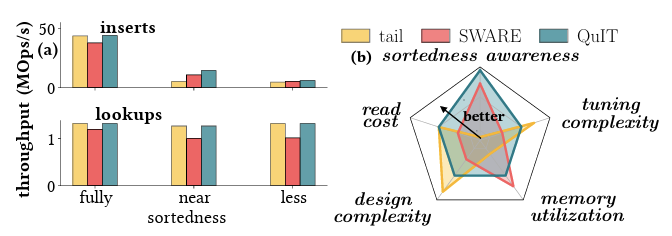
Real-world data is almost never uniformly random. Time-series aggregates, log-based server data, event-based sensor streams, and even stock tickers arrive close to sorted on their natural key; in TPC-H’s lineitem table, ordering the data on shipdate leaves commitdate and receiptdate nearly sorted as well [1][3]. Yet classical index designs are built for the two extremes of sortedness — scrambled data (regular insertion) and fully sorted data (bulk loading) — and pay the same construction cost for everything in between, as if every key were adversarial. Since indexing is precisely the act of adding order to incoming data, the indexing effort should be minimal when the data arrives with some intrinsic order.
Our research treats sortedness as a first-class resource: something that can be measured, benchmarked, and exploited to dramatically accelerate ingestion without compromising query performance. The thread runs from BoDS [4], the first benchmark to expose sortedness as a controlled experimental axis, through SWARE [3], a design paradigm that retrofits any tree index with sortedness-awareness, to QuIT [1], which distills the idea to a nearly zero-overhead design.
Can we design indexes that learn from the order in which data arrives — and exploit partial sortedness without sacrificing lookups when data is not sorted?
Measuring Order: The (K, L)-Sortedness Metric
Exploiting sortedness first requires quantifying it. We adopt the (K, L)-sortedness metric of Ben-Moshe et al., which captures disorder along two independent dimensions: K, the number of entries that are out of order, and L, the maximum displacement of an out-of-order entry from its sorted position [1][4]. Unlike simpler measures (inversions, runs, exchanges), (K, L) distinguishes how many entries are misplaced from how far they strayed — a collection with few but distant outliers behaves very differently from one with many small local swaps.
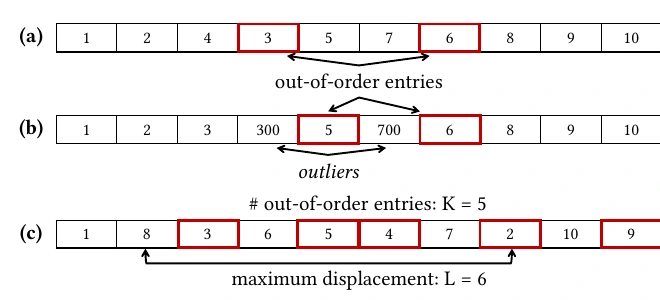
BoDS [4] builds a benchmark around this metric: a variable-sortedness data generator (with a user-specified distribution for L) and five workload types — pure bulk loading, one-by-one insertion, and mixed read/write workloads with and without preloading. Running BoDS on PostgreSQL confirms the motivating suspicion: a production-grade relational system cannot exploit intermediate sortedness — ingestion cost stays essentially flat as data approaches sorted order — quantifying the headroom that sortedness-aware designs can claim.
SWARE: A Paradigm for Sortedness-Aware Indexes
SWARE [3] is not a new index but a meta-design: a framework that converts any tree index into its sortedness-aware counterpart. It combines four design elements: (i) fast-path insertion that sidesteps the root-to-leaf traversal for in-order entries; (ii) opportunistic bulk loading that ingests sorted runs at bulk-load speed; (iii) variable fill and split factors — splitting nodes 80:20 rather than 50:50 when data trends sorted, which packs nodes fuller and avoids the pathological half-empty nodes a B⁺-tree produces under sorted insertion; and (iv) an intelligent buffer that captures near-sortedness before it reaches the tree.
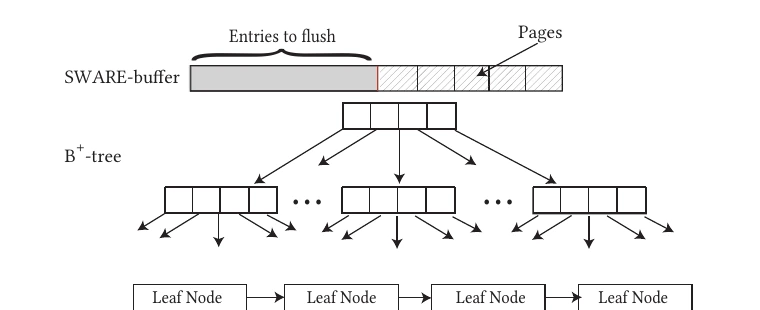
The buffer is where the subtlety lives. Flushing is partial and opportunistic: only the sorted, non-overlapping fraction of the buffer is bulk-loaded, so sorting work is never wasted. Because every query must now also check the buffer, SWARE keeps that overhead nominal with a layered read path — Zonemaps to identify overlapping pages, a global Bloom filter plus per-page Bloom filters to skip the unsorted section, interpolation search over the sorted section, and query-driven partial sorting (inspired by database cracking) that lets queries progressively add structure to the buffer [3].
Applied to a B⁺-tree and a Bε-tree, SWARE delivers up to 8.8× and 7.8× faster ingestion, respectively, for write-heavy workloads on near-sorted data, with overall benefits of 1.3–5× for mixed read/write workloads and up to 48% better space utilization [3].
QuIT: Sortedness-Awareness at Near-Zero Overhead
SWARE buys its gains with a buffer, auxiliary filter structures, and tuning — and its point queries can run up to 26% slower than the baseline. QuIT (Quick Insertion Tree) [1] asks how much of the benefit survives if nearly all of that machinery is removed. The answer: most of it — and then some.
QuIT’s key ingredient is the predicted-ordered-leaf (poℓe): a single in-memory pointer to the leaf where the next in-order key is predicted to land. Its precursor, the last-insertion-leaf (ℓiℓ), already improves on the tail-leaf fast-path used in production systems (e.g., PostgreSQL), which collapses to almost no fast-inserts with just 1% out-of-order entries; ℓiℓ sustains 98% fast-inserts at that disorder level. poℓe goes further: on a node split it predicts which of the two resulting nodes future in-order entries will target, keeping the fast-path fresh instead of stale. When the prediction misses, QuIT simply falls back to a standard root-to-leaf insert — so on scrambled data it is exactly a B⁺-tree, and its benefits come with no read penalty. The required metadata is one pointer and a handful of boundary keys.
QuIT also adapts its split policy through the In-order Key estimatoR (IKR), inspired by the inter-quartile range: when incoming data trends sorted, splits leave more room in the predicted-hot node and redistribute entries to under-utilized neighbors, packing leaves tighter. The result is an index that ingests up to 2.3× faster than a tail-leaf-optimized B⁺-tree and up to 2× faster than SWARE on near-sorted data, serves point lookups up to 1.32× faster than SWARE, improves memory utilization by up to 49% over a B⁺-tree, and touches up to 2× fewer leaf nodes during range queries thanks to denser packing [1] — all with essentially no tuning and no added read cost.
Key Results
Outlook
The arc of this project — benchmark, paradigm, minimal design — argues that sortedness belongs alongside selectivity and skew as a standard axis of index design. The BoDS results show production systems leave this performance on the table today; SWARE shows how much can be claimed with a full framework; QuIT shows the price of admission can be a single pointer. The natural next steps run in both directions: pushing sortedness-awareness into LSM ingestion paths and production storage engines, and generating controlled near-sorted workloads at scale — which our Tectonic benchmark generator [2] already supports — so that any index can be evaluated honestly on the data it will actually see.